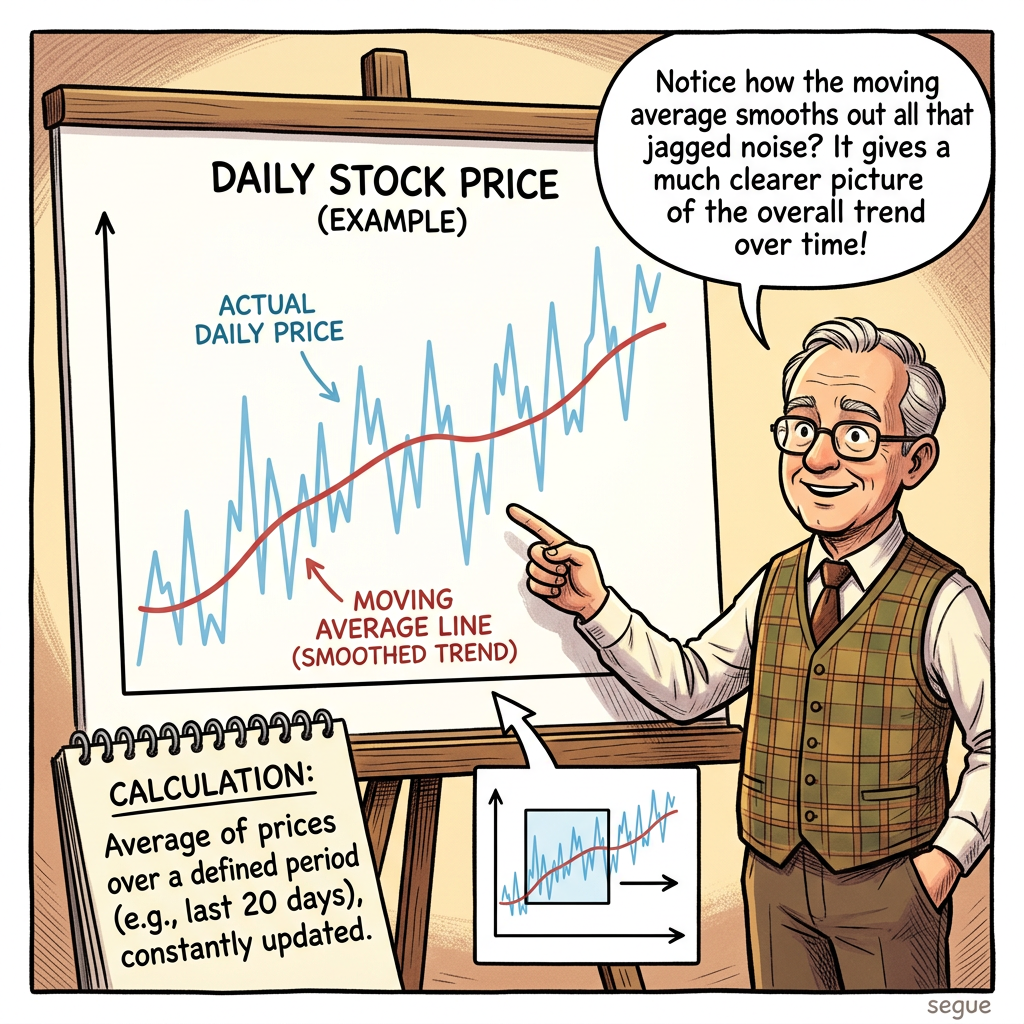
moving average
/ˈmuːvɪŋ ˈævərɪdʒ/
a calculation that smooths price data by creating a constantly updated average price over a defined period
moving average in a sentence
“When the 50-day moving average crossed below the 200-day, traders interpreted it as a bearish signal.”
Origin of moving average
Old English movig + Latin averagium from Arabic awariya damaged goods — later mean of data
Related Words
candlestick
a chart element showing the open, close, high, and low prices for a period, resembling a candle
breakout
when a price moves above a resistance level or below a support level with increased volume
dead cat bounce
a temporary recovery in a declining asset's price, followed by a continuation of the downtrend
head and shoulders
a chart pattern with three peaks — a higher middle peak flanked by two lower ones — signaling a trend reversal
RSI
relative strength index — a momentum oscillator measuring the speed and magnitude of recent price changes, scaled 0 to 100
MACD
moving average convergence divergence — a trend-following momentum indicator showing the relationship between two moving averages