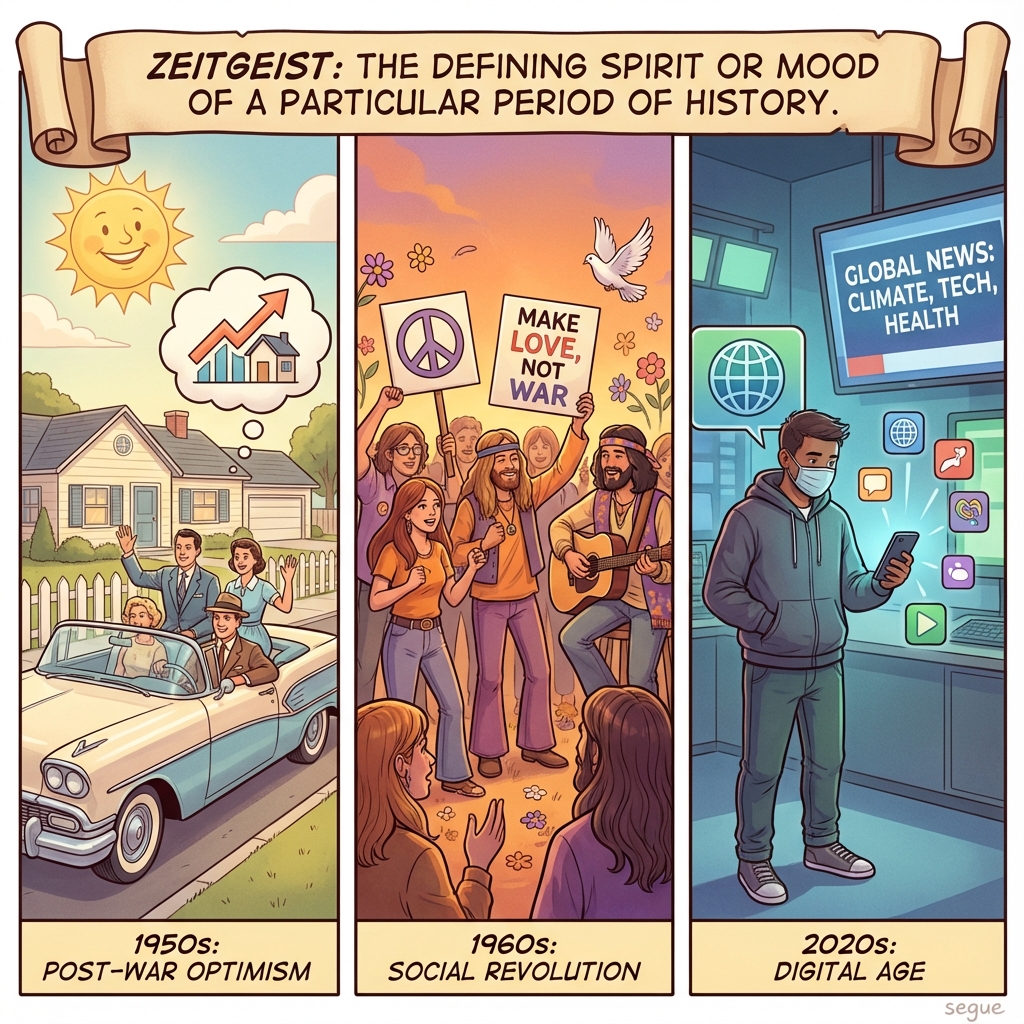
zeitgeist
/ˈtsaɪtɡaɪst/
the defining spirit or mood of a particular period of history
zeitgeist in a sentence
“The art captured the zeitgeist of the revolutionary era.”
Origin of zeitgeist
German Zeitgeist from Zeit time + Geist spirit
What does zeitgeist really mean?
The zeitgeist is the mood of an era — the cluster of beliefs, anxieties, and tastes that feel self-evident to the people living inside it and obvious only in hindsight. To "capture the zeitgeist" is to express what everyone was feeling before they could articulate it.
The story behind zeitgeist
German, from Zeit (time) and Geist (spirit or ghost). The term grew out of German Romantic philosophy — thinkers like Herder and Hegel argued that each age has a governing spirit that shapes its art, politics, and ideas, and that individuals think within it.
How to use zeitgeist
Use it in cultural commentary: a film, album, or product can "capture," "define," or "tap into" the zeitgeist. It usually takes the definite article — the zeitgeist — and suits analytical or journalistic writing more than casual speech.
Related Words
weltanschauung
a particular philosophy or view of life; a worldview
a priori
relating to knowledge that is independent of experience
a posteriori
relating to knowledge derived from observation or experience
tautology
a statement that is true by necessity; needless repetition of an idea
paradox
a seemingly absurd statement that may actually be true
dichotomy
a division into two mutually exclusive or contradictory groups