How to Remember VocabularyWhat memory research actually says
A word is not yours because it looks familiar. For practical vocabulary, remembering means recovering its meaning after a delay, distinguishing it from a near neighbor, and using it beyond the sentence that taught it.
A flashcard is only a stage. It can make you retrieve a meaning before the answer appears, or let you glance at the answer and move on. The rectangle is the same; the mental act is not. One rehearses recovery. The other is rereading in miniature.
Memory research does not hand us one magic interval or daily quota. It gives us a more useful loop: understand the word, recall it without looking, check the answer, return after a delay, and use it in more than one context. Etymology and imagery can make the trail easier to find, but neither can walk it for you.
The Card Is Not the Practice
Working memory is limited. Under carefully controlled conditions, cognitive scientist Nelson Cowan argued for a capacity of roughly four chunks, while stressing that the estimate depends on how rehearsal and grouping are controlled. That finding is not a rule that you may learn only four words a day. It is a reason to keep each learning step focused. (Cowan, 2001)
Recognition only
- Read the prompt and reveal immediately
- Judge the answer as familiar
- Repeat the same card in the same order
- Record confidence instead of performance
Retrieval practice
- Pause and produce an answer first
- Check it against clear feedback
- Try meaning-to-word and word-to-meaning
- Return after enough time to make recall effortful
Give Recall Something to Find
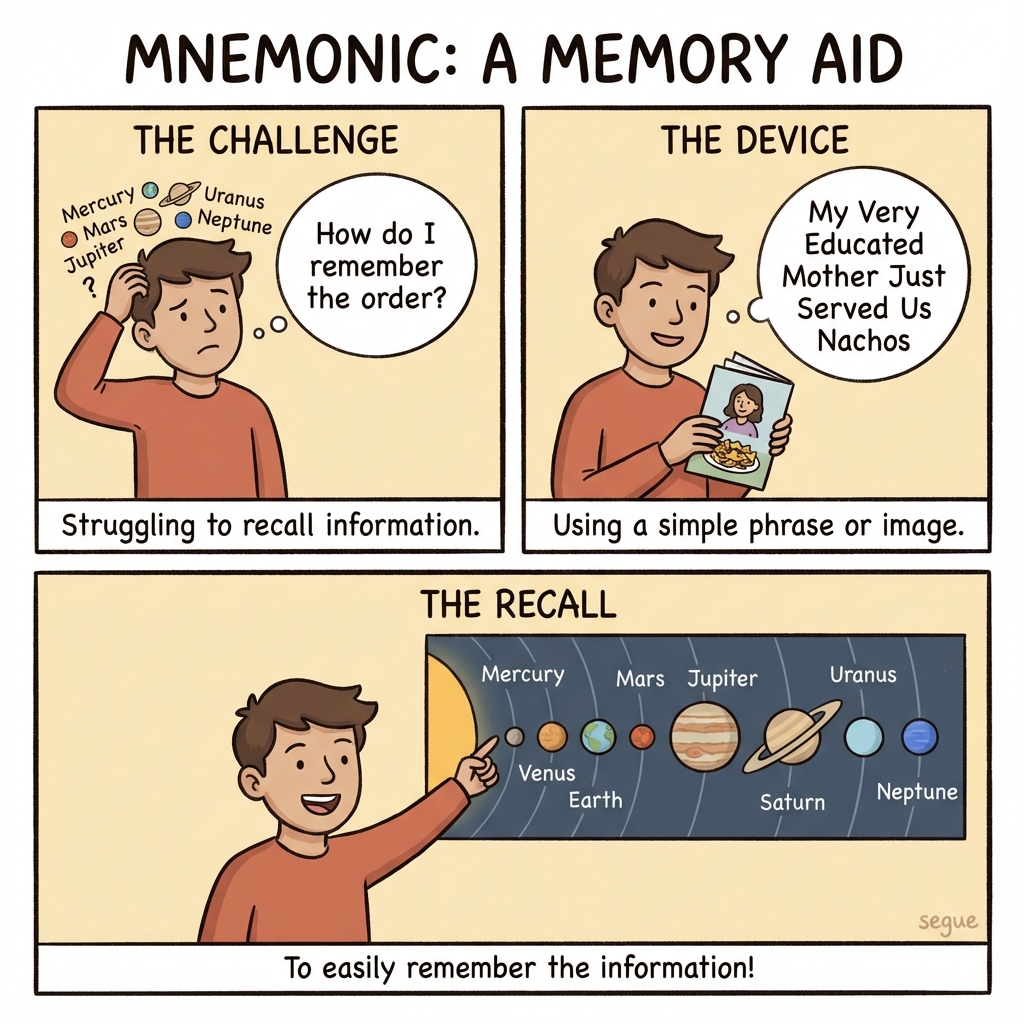
Before you test a word, give yourself something worth retrieving: its pronunciation, a plain definition, one natural sentence, and a contrast with a nearby word. A vivid image or verbal hook can make that first representation easier to find.
Take benevolent. Its history joins Latin bene, meaning well, with velle, to wish. The compact cue “wishing someone well” points toward the modern meaning. It is a cue, not the whole definition, and it still needs examples. (Merriam-Webster)
The Forgetting Curve, Without Fake Precision
Hermann Ebbinghaus did establish a durable idea: accessibility tends to fall with time, and the decline is often steepest early on. But his famous experiments used lists of nonsense syllables, with Ebbinghaus himself as the subject. A modern replication found a similar broad curve while also showing how the result changes with method and material. (Murre and Dros, 2015)
The curve does not license claims that every learner forgets a fixed percentage after twenty minutes, a day, or a month. Prior knowledge, attention, sleep, retrieval cues, and the test itself all matter. Use forgetting as a scheduling problem, not a countdown.
A more honest reading of the curve
- It does suggest
- One exposure is fragile, and delayed review is useful.
- It does not predict
- Your personal retention percentage at a given hour.
Delay Is Part of the Lesson
Spacing means distributing study over time instead of packing the same repetitions into one sitting. A large review by Nicholas Cepeda and colleagues synthesized 839 assessments from 317 experiments and found a reliable advantage for distributed practice. It also found that the best gap depends on how long you hope to retain the material. (Cepeda et al., 2006)
Treat the schedule as an estimate
Review after a meaningful delay. If recall is easy, lengthen the next interval. If you fail, restore the answer and shorten it. A fixed 1-3-7-14-day sequence can be a starting point, but it is not a law of memory.
Familiarity Is Not Recall
In a widely cited experiment, Henry Roediger and Jeffrey Karpicke asked students either to restudy prose passages or to recall them without feedback. Restudy helped on a test five minutes later; prior testing produced better retention after two days and one week. The study was about prose, not vocabulary, but its central lesson transfers cleanly: looking again and trying to remember are not interchangeable. (Roediger and Karpicke, 2006)
Make the attempt before revealing the answer. Say the definition, type the word, or write a sentence. Then check. An unsuccessful attempt with feedback is useful evidence; an unchecked guess is not.
A Word Needs More Than a Definition
A word is more than a definition pair. You also need to know what it modifies, which prepositions accompany it, what register it belongs to, and where its apparent synonyms stop matching. That knowledge comes from varied examples and use.
Research on foreign vocabulary learned through stories found that both retrieval opportunities and informative contexts improved later retention over words omitted from the story. When initial retrieval was difficult, context that made the meaning inferable could be especially useful. The practical choice is not context or retrieval; it is an initial explanation followed by both. (van den Broek et al., 2022)
Keep practice calm enough to repeat, but do not turn “flow” into another requirement. A timer does not automatically prevent learning, and a serene interface does not guarantee it. The useful design choice is low friction: short sessions, clear feedback, and an obvious next review.
Etymology as a Cue, Not a Shortcut
Word histories are memorable because they connect unfamiliar forms to material you may already know. They can also mislead: meanings drift, and modern usage is not determined by a word's oldest parts. Learn the history, then return to current examples.
Benevolent
Latin bene (well) + velle (to wish): a useful cue for wishing someone well.
Check the word historyMnemonic
From Greek mnemonikos, related to being mindful or remembering. Its own difficult spelling makes it a good candidate for a mnemonic.
Check the word historyGregarious
From Latin grex, a flock or herd. The social sense is easier to recall once you picture a group gathering.
Check the word historyTurn the Evidence Into a Routine
- Encode: read the definition, pronunciation, and one natural example.
- Connect: add an image, word root, contrast, or personal association.
- Retrieve: hide the answer and produce it before checking.
- Correct: compare your answer with the full meaning, not just a keyword.
- Space: return later, lengthening the gap after successful recall.
- Vary: encounter the word in new sentences and use it yourself.
Memory palace
Put a word at a vivid point on a familiar route. To remember gregarious, imagine a crowded reception in your otherwise quiet hallway.
Review the evidence for the method of lociKeyword method
Link a new form to a familiar sound, then connect that sound to the meaning with an image. For pernicious, the sound of “vicious” can cue something harmful. Check the real pronunciation so the hook does not replace the word.
Read a vocabulary-learning experimentPersonal sentence
Write something concrete enough to picture: “Coffee shops are ubiquitous on this block, but a quiet table is rare.”
Contrast pair
Put near-opposites side by side and explain the distinction: a garrulous guest talks at length; a taciturn one says very little.
Adjust the Routine, Not the Evidence
Daily load, review intervals, and study time can bend around a real life. The underlying work does not change: retrieve before revealing, correct the miss, return after a delay, and meet the word in more than one setting.
How many new words should I learn per day?
There is no research-backed number that fits everyone. Choose a load that leaves time to review older words. If the review queue keeps growing, add fewer new ones.
Why do I forget a word I just learned?
Initial familiarity is not the same as recall. Try to retrieve the meaning, restore the answer when you miss, and revisit it after a shorter interval.
Are flashcard apps effective for vocabulary?
They can be. The useful parts are retrieval, corrective feedback, spacing, and good examples. Merely revealing familiar cards is a weak test of learning.
How long does it take to learn a word?
There is no fixed encounter count. Recognizing a word, recalling its meaning, and using it naturally are different levels of knowledge and develop at different rates.
Should I learn words in context or in isolation?
Use both. A direct word-to-meaning prompt is efficient for initial recall; varied sentences teach grammar, register, collocations, and nuance.
What is the best time of day to study?
The time you can repeat consistently is usually the practical answer. Do not trade sleep for another review session: sleep generally supports consolidation of newly learned words.
Read the systematic reviewRemembering Is What Survives the Page
To remember a word is not merely to have seen it before. It is to retrieve the meaning after time has passed, reject a near miss, and place the word naturally in a sentence that was not memorized with it.
The practical consequence is a design principle: make recall necessary, correction immediate, and return likely. Cards, roots, images, and schedules are useful insofar as they serve that loop. That is less magical than a perfect retention curve, and far more useful.
Practice the loop
Choose a small collection, retrieve before revealing each answer, correct the misses, and return after a delay. The method matters more than the streak.
Browse vocabulary collections