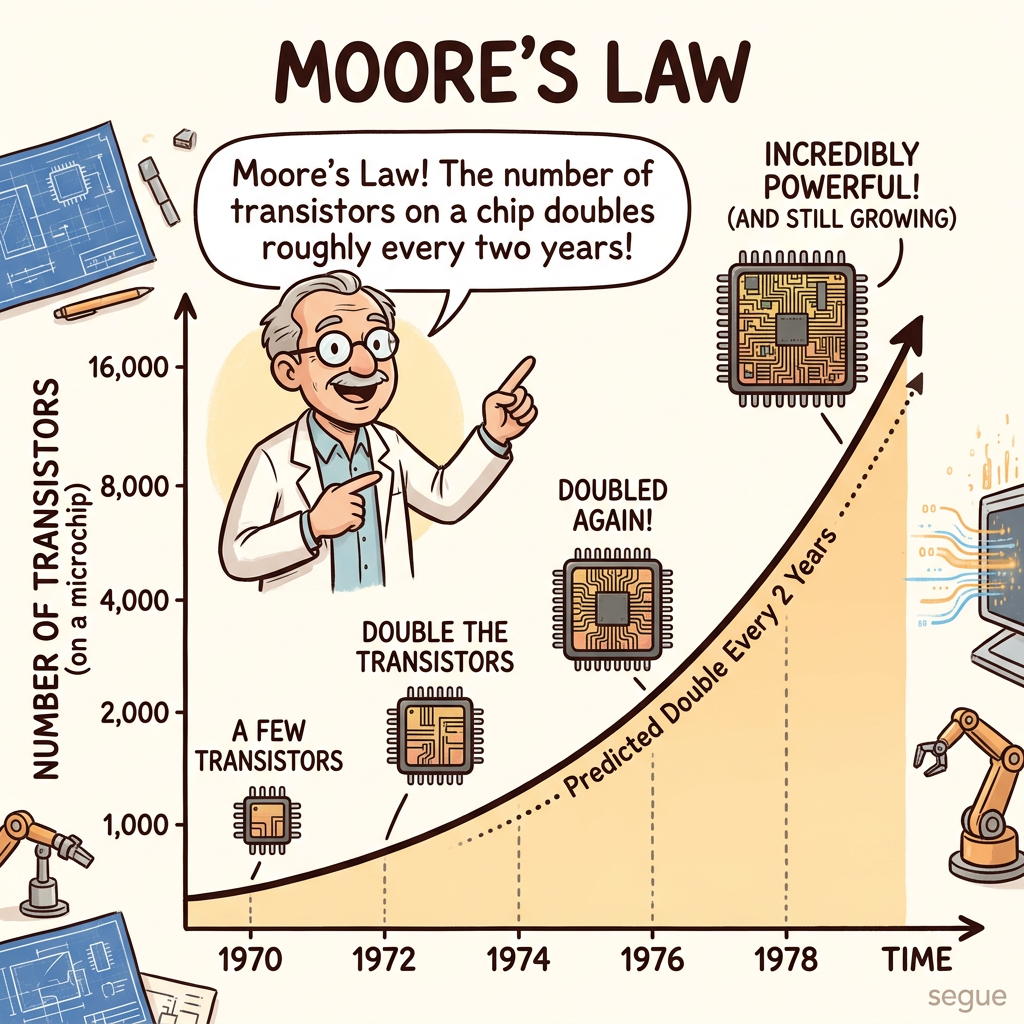
Moore's Law
/ˈmɔːrz lɔː/
the observation that the number of transistors on a chip doubles approximately every two years, driving decades of computing progress
Moore's Law in a sentence
“Engineers debate whether Moore's Law is slowing as physical limits approach atomic scale.”
Origin of Moore's Law
Named for Gordon Moore, Intel co-founder, who made the prediction in 1965
Related Words
SoC
System on a Chip; an integrated circuit that combines all components of a computer—CPU, GPU, memory controller, and I/O—onto a single die
chiplet
a modular, small die designed to connect with other chiplets in a single package, enabling flexible chip assembly
EUV
Extreme Ultraviolet lithography; a technology using 13.5nm wavelength light to print the finest circuit patterns, essential for advanced nodes
FinFET
a transistor architecture where the channel rises vertically like a fin, enabling better current control at small scales
IP core
a reusable, pre-designed circuit block licensed from a third party and integrated into a custom chip
ASIC
Application-Specific Integrated Circuit; a chip custom-designed for a single task, optimizing performance and efficiency